

table of contents
- Problems with the Traditional Method
- Problems with the traditional educational model include:
- Education Qualification (Skill enhancement)
- LinkedIn Learning
- Pluralsight
- Udemy for business
- Coursera
- Skillsoft
- uQualio
- Mind Tools
- Cornerstone
- Recruitment
- Verified Certifications
- Monthly Subscriptions
- Online Degrees
- Coursera for Business
- Step 1: Figure out your business model
- Step 2: Figure out your categorization system
- Step 3: Make a good recommendation pattern
- Step 4. Create a flexible authentication system
- Step 5. Create a good and extensive user profile
- Step 6. Creating a course purchase system
- Step 7. Creating a notification system
- Step 8: Creating a blog
- Step 9. Integration with corporate portals
- Step 10. Support
- Step 11. Administrative dashboards and analytics
- Step 12. Creating an intelligent course creation system
- Step 13. Course Analytics
- Step 14. Technology Stack
Education has been the single biggest driver of growth, development, and innovation around the world. Formal education was highly sought after since ancient times and was at that time reserved for the wealthy or the powerful. The ancient world had many notable institutions of higher learning, some of which include:
- The Platonic Academy (Founded ca. 387 BC)
- The Peripatetic School (Founded ca. 335 BC)
- Pushpagiri (Founded ca. 3rd Century AD)
- Nalanda (Founded ca. 5th Century AD)
- Taehak (Founded ca. 370 AD)
- Gondishapur (Founded ca. 3rd Century AD)
These universities or academies were centers of excellence, founded by great thinkers and philosophers who wanted their research and ideas to be propagated and research to be the building block of civilization. Although most of these universities do not exist in their original form but the seed they sowed built the foundation on which great centers of learning are being built today.
Traditional Methods of learning
Most centers of learning, whether they are schools, academies or colleges rely on the traditional method of education. This is well depicted in this illustration from the 14th century that shows a university lecture hall in Italy. Teaching is instructor-led and follows a strict curriculum, which is required as a minimum qualification to progress to the next level. Although this works well for most of us as we start going to school at a particular age and then move to universities for higher education, however, there are some that cannot follow this regimen due to many reasons.

Problems with the Traditional Method
The traditional method of education relies on the availability of the instructor and the students. This method also requires the student to be available at the same location as the instructor, making it impossible for those who are working to get an education.
A student would be required to quit his job and then work towards enhancing their qualification, something that not everyone would find financially viable. This coupled with the limitation of the availability of the instructor at a particular location has dissuaded many students from furthering their education.
Distance education was envisioned as a bridge that could fill this gap but has not been able to due to the fact that distance education relies on the student reading course material on his own, and then giving an examination to test his skills which is the same as those attending regular courses.
This creates a gap between the skillset of those being instructed by an instructor in real-time and those reading notes to gain that knowledge. A second attempt at this was through the process of e-Learning, which was considered to bridge this gap with televised education, but still was not completely able to solve the problem of skill acquisition by existing workers.
Programs offered in e-Learning were traditional university courses that sometimes would not solve the problems of learners as they needed to learn specific skills that were not a part of their field of study.
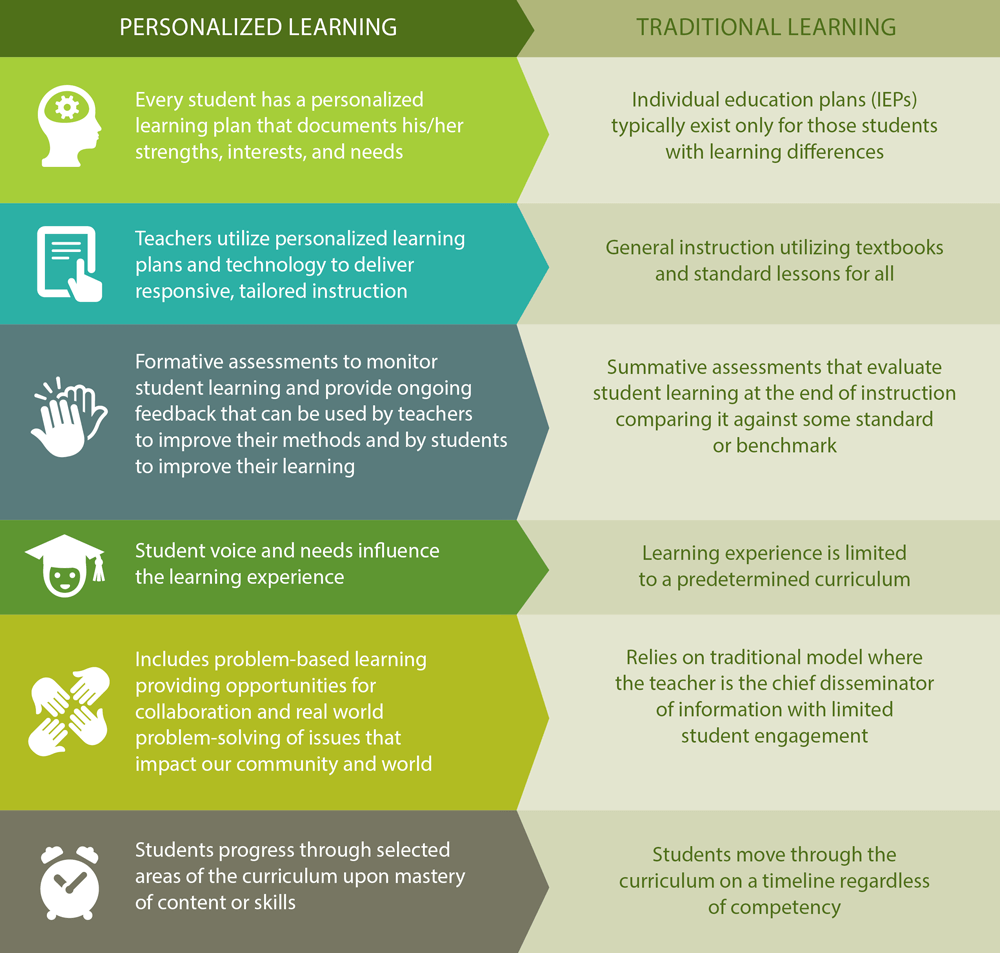
Problems with the traditional educational model include:
-
Delivery
Instructors can only be available at one location at a time. Even if classes are televised, those in different time zones find it difficult to fit the delivery model.
-
Reach
Although progress was made by the traditional education model to enhance the reach of classrooms by televising classes and e-Learning, many were not able to reach these locations where lectures were televised or did not have the resources to complete a formal educational regimen.
-
Time
For working professionals, time is of the essence as they can only study during their free time. eLearning requires a full day of learning, which is sometimes not possible for working professionals. This system also does not work for students who wish to enhance a skillset.
-
Cost
As e-Learning systems can cost as much as traditional university education, those with financial constraints find it difficult to pay for an instructor-led course, causing many to drop out or not register for a course altogether. This has particularly been a cause of concern for the underprivileged, who are unable to acquire employment skills due to financial constraints. A note regarding this was forwarded by Prof. Asha Sethi, IDC India, linking the cost of education with rising dropout and non-registration rates.
-
Age
Traditional learning methods have a standard teaching methodology. This makes it difficult for learners of advanced age levels to adapt to traditional education regimens at an advanced age or at a later stage in their career, where specifics matter more than holistic coverage.
Education Qualification (Skill enhancement)
Many individuals progress to a more technical role in their career due to their experience and long association with the industry they work in, making them subject matter experts in their field. These individuals do not have a formal education in the field but have gained relevant knowledge through experience. For these individuals, restarting education hits a roadblock as they may not have the basic qualification that is required for joining continuing education systems or enhancement courses.
How is technology revolutionizing the domain of education?
Enter technology. For years, technology has been envisioned as the solution to our educational needs. From educational aids like slide projectors to computers, technology has always been at the forefront of education, helping educators deliver better, richer, more information-filled content to their students.
Technology helps teachers create better instructional materials and learning methodologies that help students learn faster and retain more. Technology has also helped students to emulate a real-world environment for their learning by using models and simulators. With the advent of the internet, the availability of information became ubiquitous, and this came as a boon to the education industry.
The internet converted education into educational technology and brought information to the masses, something that was not possible with traditional televised media. This was further fuelled by the mobile phone revolution after the advent of the iPhone when mobiles were able to display feature-rich content better than ever before.
The availability of feature-rich content was still nascent as most of the information or the content available on the internet was on websites, and websites found it difficult to display content the way they could on a large screen. Even as phone screens became larger and websites became responsive, it was difficult for websites to emulate an optimal user experience on the phone.
The iPhone ushered in the era of mobile apps. Education was quick to follow suit. As more and more websites converted into mobile apps, education was finally in the hands of those who needed them the most.
Education technology had leveraged the power of the internet to successfully morph into eLearning, a term coined in 1999 at a CBT systems seminar that described the delivery of lessons online. eLearning continued to evolve over the years and finally found its calling in the concept of MOOC, or Massive Open Online Courses.
MOOCs gave people the ability to study at a location of their convenience, at a time of their convenience, for a course of their liking. This was further enhanced as major international universities started offering skill enhancement courses on these MOOC platforms, allowing learners across disciplines and experience levels to take courses that they really needed instead of degree or diploma courses.
As MOOC platforms started to offer certifications and courses from reputed universities, business establishments started to become interested in these systems to allow their employees to learn on the job, ensuring that employees are able to enhance their skill set and it ensured that employees who availed of these opportunities were retained by their institutions for longer durations.
Offering courses for individuals and businesses allowed these MOOC platforms to successfully monetize their platforms, ensuring that individuals get certified from reputed international universities globally. This also gave an opportunity to universities to offer degrees on MOOC platforms, ensuring that individuals who had a zeal to learn, could do so at their own pace without sacrificing quality.
Several MOOC platforms have come up recently and offer interesting combinations of courses and degrees to their subscribers.
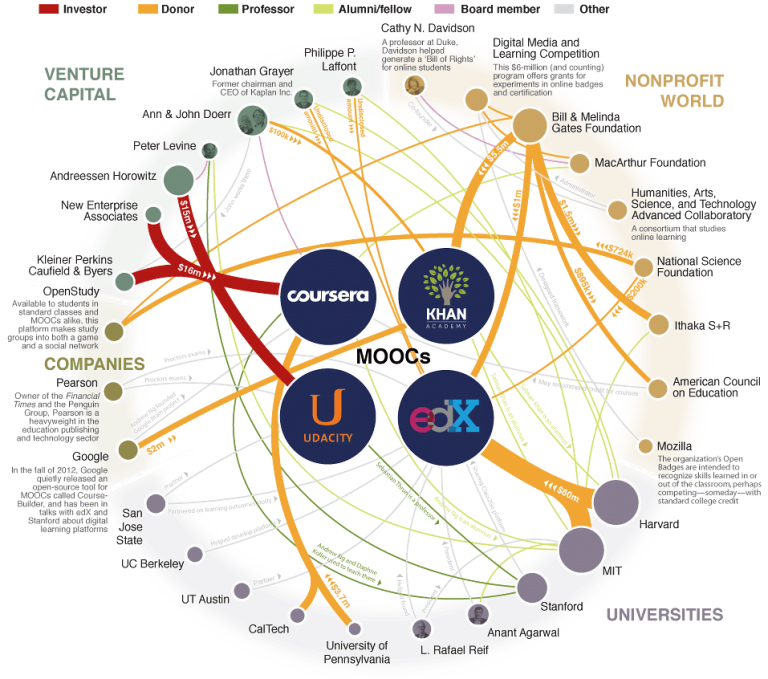
Some of these major MOOC platforms include:
-
LinkedIn Learning
Offered by the popular corporate social networking platform LinkedIn, LinkedIn Learning offers courses led by experts that help teams and organizations enhance the skills of their employees. LinkedIn Learning also helps organizations bring custom content onto the platform that makes these courses more relevant to them. LinkedIn Learning is primarily a video-first platform.
-
Pluralsight
Envisioned as a platform that helps employees upskill across various domains, Pluralsight has high-quality specialized courses that are authored by experts and allow individuals and organizations to track their employees learning path. They, however, do not offer any certified courses as of now.
-
Udemy for business
Launched by one of the premier MOOC platforms, Udemy for Business is a corporate learning platform that offers in-depth courses across a variety of topics. With a user-friendly interface and learning progress tracking capability, Udemy for Business is considered one of the best online learning platforms for corporates.
-
Coursera
Considered the go-to platform for MOOCs, Coursera is one of the most well-known platforms for online learning globally. With certified courses from major universities and corporations, Coursera offers a wide variety of certified courses that can be offered to businesses with an enterprise plan.
-
Skillsoft
Skillsoft is a major corporate eLearning platform that offers both short and long terms courses for a variety of domains.
-
uQualio
A high-end video-based eLearning platform, uQualiio has the distinct advantage of offering gamification, that lets individuals build their own courses as per need. uQualio has a lot of bite-sized content that can be used by individuals to learn on-the-go.
-
Mind Tools
Online management and leadership training platform with a focused catalog of courses, MindTools allows users across levels to learn about management, leadership and business-related content. Most of the course material on MindTools is in article format.
-
Cornerstone
Cornerstone is a subscription-based eLearning platform that allows organizations to get tailor-made content for their employees.
These platforms have made eLearning the cornerstone of continuing education and have allowed individuals and corporates to upskill and enhance their educational qualifications. Of all the platforms mentioned above, two of the most well-known platforms here are Coursera and Udemy.
E-learning Player in Focus
Founded in 2012 by Stanford professors Andrew Ng and Daphne Koller, Coursera is one of the most well-known platforms offering MOOCs the world over. Coursera is known for having collaborated with universities around the world to provide high-quality content that includes specialized courses in a variety of subjects including engineering, data science, machine learning, mathematics, science, business, digital marketing, medicine, biology, social sciences and more.

Coursera started offering online degrees in 2017, starting with masters in Innovation and Entrepreneurship from HEC Paris. They have since moved on to offer a variety of degrees from the University of Illinois and many more.
Fueled with an initial funding round of $16 million by Kleiner Perkins Caulfield & Byers and New Enterprise Associates, Coursera has grown by leaps and bounds in several funding rounds and is valued at over $1 billion today.
So how does Coursera make money?
Coursera has tried several business models since 2012. Their first attempt at monetizing their service was in the first year of inception.
-
Recruitment
Coursera pitched their first monetization attempt through their blog called Career Services. This was a recruitment service that connected Coursera’s 2 million students with companies that needed those skills.
Using data analytics and intelligent algorithms, Coursera matched students to companies with minimal bias. Companies were charged a flat fee for matched students. Companies that took part in this service included Facebook, Twitter, AppDirect, and TrialPay.
-
Verified Certifications
In early 2013, Coursera started its Signature Track courses. Considered a major initial driver of funds, Coursera today makes over $1 million per month in signature course revenue alone. These courses offer a Verified Certificate of completion that securely links coursework to a real identity. Coursera ended its free certificate track in 2014.
-
Monthly Subscriptions
Since 2016, specialization courses at Coursera are available as a subscription. Participants for subscription courses can enroll for 7 days for free and then pay a fixed price per month for these courses. These courses prompt learners to quickly complete courses as they can reduce the amount of money they pay per course.
Online Degrees
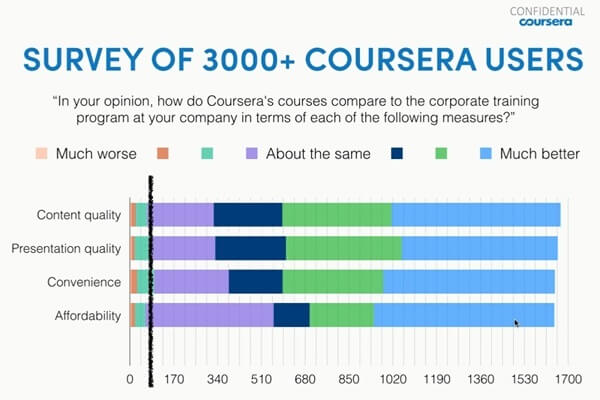
In 2015, Coursera invited interest from universities that wished to offer specialty programs on their platform. From the first program on Entrepreneurship to over 15 degrees today, Coursera has a wide variety of courses on offer that cost much less than corresponding courses in universities.
-
Coursera for Business
Coursera for Business helps organizations requiring a platform to train their employees. This service is highly sought after and used by many corporates globally. The Abu Dhabi School of Government has over 60,000 users on this platform alone. Increasing demand and a growing consumer base have made Coursera for Business a key component of Coursera’s earnings strategy.
Although Coursera keeps its revenue information private, it is estimated that with a net worth of around $1 billion, Coursera is currently raking in around $140 million+ in revenue alone. This makes Coursera a high-revenue, high-value investment for many investors. With over $300 million in nine fundraising rounds to date, Coursera is a company that has maintained its leadership in the market.
How to build an e-learning Platform like Coursera or Udemy?
Building an eLearning platform like Coursera is a daunting task that requires serious thought and investment. The single biggest driver for this cause is that over 70 million jobs will be lost by 2030 due to automation alone. This requires serious thought as individuals need to upskill and ensure that they stay competitive in this already saturated job market.
Step 1: Figure out your business model
The first step towards building a platform is to figure out how the platform will work. Platforms like Coursera mainly attract universities and organizations as course contributors or create their own courses for consumption by subscribers. If you wish to offer a platform where nearly anyone can create and manage courses, you should try an ed tech business model like that of Udemy.
Step 2: Figure out your categorization system
If your users cannot figure out where your courses are or how to search for them, you will end up losing users. Creating algorithms that organize courses effectively is a good way to ensure that users do not get confused and find the course they need.
Step 3: Make a good recommendation pattern
Most users pick up courses that were recommended to them according to their profile and past course history. Using data analytics to suggest courses to you is a good way to ensure users stay hooked and find out about new courses that are trending, popular or according to their viewing interests.
Step 4. Create a flexible authentication system
A robust and flexible authentication system helps users trust your app. This will further help them sign on using single-sign-on or other related methods.
Step 5. Create a good and extensive user profile
User profiles can help you gather information about the persona you wish to recommend courses to. The deeper the level of detail, the better your recommendation will be. Users must also be able to view their course lists, download certificates and check their past purchases in their profile.
Step 6. Creating a course purchase system
A secure and stable course purchase system is essential for a website like Coursera. Users must be able to purchase the course they wish to. Adding a free trial for each course can further entice users.
Integration with popular payment systems and types including e-wallets, internet banking and cards. This helps users pay using the method that is most comfortable for them.
Step 7. Creating a notification system
A notification system that includes e-mails, push notifications and SMS messaging on demand is essential for a platform like Coursera. This will also enable administrators to send information about events happening around the area users might be in, prompting them to attend those events or join shoutouts of their interest.
Step 8: Creating a blog
A blog can go a long way in ensuring that current and prospective students can get to know about what is new with your platform. Upcoming courses, new features, and other information can be pushed via your blog, ensuring that it not only informs but also drives organic growth to your platform.
Step 9. Integration with corporate portals
Governmental organizations and corporates might wish to utilize your platform for integration with their existing learning management system. A well-designed API can help your system integrate well, helping you showcase an organization’s confidence while using your platform and garnering newer customers with their names.
Step 10. Support
Offering world-class support is imperative for a system like Coursera. With millions of students and thousands of courses, a platform that does not have a support system becomes a nightmare. Using machine learning to offer support to those who need it the most can go a long way in ensuring students that stick to your platform.
Step 11. Administrative dashboards and analytics
Analytics and administrative dashboards help administrators manage and control users and courses on their platform. With powerful analytics at their disposal, administrators can make informed decisions, helping instructors and students benefit from these statistics.
Step 12. Creating an intelligent course creation system
A robust and well-structured course creation system helps instructors create well-designed, quality courses that will fulfill all the requirements of your course posting engine. An intelligent course creation wizard will also ensure that students find the quality of your courses consistent across domains.
Step 13. Course Analytics
Course analytics allows administrators and instructors to ensure that the course is progressing as envisioned. This should also allow instructors to view the performance of the course in terms of revenue, student count, completion percentage, etc.
Step 14. Technology Stack
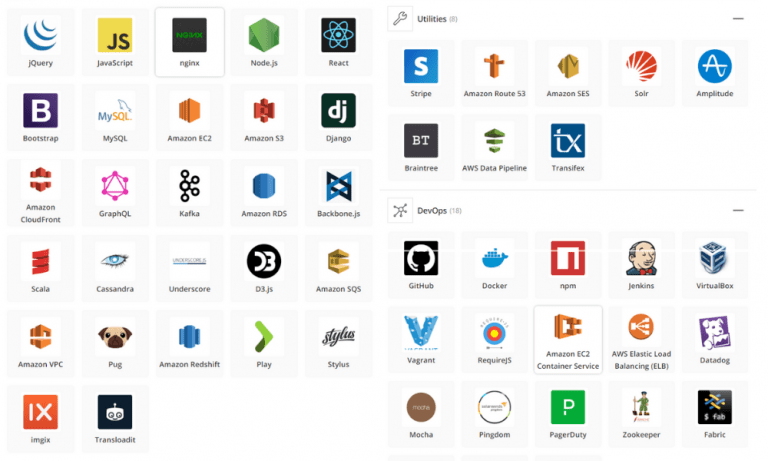
According to our dev team, the best tech stack for a platform like Coursera would include the following:
Languages: Scala/JavaSript/PHP/Python
Web Server: NGinX
Storage: Amazon S3
DB: Amazon Relational DB, MySQL
Search: Amazon CloudSearch, Elastic Search
So how much does it cost to create a platform like Coursera?
Large platforms like Coursera have many costs that may be recurring or fixed.
- Fixed costs include development costs. These may easily range between $17000 and $20,000.
- Recurring costs include infrastructure (Amazon DB and Storage costs, Hosting costs et al) and instructor payments. These range between $25,000 and $35,000.
Other recurring costs may include promotions, legal, and marketing costs that may vary according to region. Volumetree has many partners they can refer you to for legal and marketing solutions. Contact our team for more information.
How can Volumetree help you?
With Volumetree’s extensive experience building apps for a variety of domains, they are a valuable partner that can help you ensure that your idea can actually succeed. Contact our sales team today for more information about how we can help you succeed in your venture.


 Global Operations


click here to investigate [url=https://infinityvvallet.io/]orca wallet appAds[/url]
other [url=https://cakewallet.cc]how to exchange on cake walletAds[/url]
read review [url=https://coinomiwallet.cc]coinomiAds[/url]
Well, I don’t know if that’s going to work for me, but definitely worked for you! :) Excellent post!
click here for info [url=https://cakewallet.cc]cake walletAds[/url]
more helpful hints [url=https://vvs.exchange]vvs financeAds[/url]
Source [url=https://vvs.exchange]vvs financeAds[/url]
look at these guys [url=https://888-casinogames.com]888 казино[/url]
Find Out More [url=https://coinomiwallet.cc]coinomiAds[/url]
check [url=https://infinityvvallet.io/]crypto wallet screenshotpcAds[/url]
click here to find out more [url=https://888-casinogames.com]888 casinoAds[/url]
browse around here [url=https://vvs.exchange]vvs chornos platformAds[/url]
original site [url=https://infinityvvallet.io/]dapp store app uiAds[/url]
Dodgers star Shohei Ohtani suffers left shoulder injury during Game 2 of the World Series
[url=https://kra012.cc]kraken2trfqodidvlh4aa337cpzfrhdlfldhve5nf7njhumwr7instad onion[/url]
Los Angeles Dodgers superstar Shohei Ohtani suffered a shoulder injury before the Dodgers’ 4-2 win over the New York Yankees in Game 2 of the World Series Saturday.
The Japanese slugger sustained a left shoulder subluxation and will undergo more testing, Los Angeles Dodgers manager Dave Roberts said after the game, adding that the team is however “encouraged” about the injury.
https://kra012.cc
kraken
“The strength was great,” Roberts told reporters. “The range of motion good. So, we’re encouraged. But obviously I can’t speculate because we don’t get the scans yet. So, once we get the scans, we’ll know more. Again, with the strength, the range of motion good, that’s certainly a positive.
A shoulder subluxation occurs when “the humerus partially slides in and out of place quickly,” according to Johns Hopkins Medicine.
With the Dodgers up 4-1 in the bottom of the seventh inning, Ohtani attempted to steal second base but was thrown out to end the inning. Ohtani, however, stayed on the ground grimacing in pain and eventually walked off the field with trainers holding his left arm.
“Obviously when you get any one of your players that goes down, it’s concerning,” Roberts said. “But after kind of the range of motion, the strength test, I felt much better about it.”
According to the FOX broadcast, microphones picked up a conversation between Ohtani and trainers saying that his left shoulder appears to have popped out of its socket.
This weekend’s playoffs mark Ohtani’s first appearance in the postseason after he missed out in each of his six seasons with the Los Angeles Angels.
The star player is riding on a series of remarkable accomplishments in recent months, including hitting his 50th homer of the season and stealing his 50th base in the Dodgers’ victory over the Miami Marlins last Thursday. Ohtani went on to rack up his 51st of each stat by the end of the contest.
click over here [url=https://vvs.exchange]miner mole[/url]
click here for more info [url=https://coinomiwallet.cc]coinomiAds[/url]
Тут можно преобрести стоимость оружейного сейфа оружейный шкаф купить в москве
Your Domain Name [url=https://infinityvvallet.io/]crypto wallet screenshotpcAds[/url]
discover here [url=https://vvs.exchange]vvs chornos platformAds[/url]
read review [url=https://vvs.exchange]vvsAds[/url]
helpful resources [url=https://infinityvvallet.io/]infinity wallet ai mine[/url]
click here for info [url=https://coinomiwallet.cc]coinomicoinomiAds[/url]
What the rising popularity of Yemeni coffee shops says about third places
[url=https://kr13at.cc]kraken сайт[/url]
The most popular spot on a late Friday night in a pocket of Manhattan’s West Village isn’t a trendy bar or a Michelin-starred restaurant but a Yemeni coffee house chain strictly serving coffee, tea and pastries.
A step into Qahwah House on Carmine Street offers a rich whiff of cardamom, Arabic music and crowds of people both at tables and in line to order. The energy spills over into the sidewalk, where some begin performing a Levantine folk dance known as dabke. It’s a snapshot of various Eastern cultures; Arabic, Farsi and Urdu fill the air, and some customers don traditional attire.
https://kr13at.cc
кракен
Qahwah House is just one of a string of Yemeni coffee chains that originated in the Arab-populated Detroit area and are rapidly springing up across the country, often where there are significant Middle Eastern and Muslim populations. Nineteen Qahwah House locations are open across seven states, with more under construction and expected to open this year. Another chain, Haraz, opened this month in the pricey SoHo neighborhood in Manhattan, with at least six more in the region planned in the next two years. Times Square will be home to two other chains, MOKAFE and Qamaria Yemeni Coffee Co.
The rapid expansion of these shops underscores the demand for late-night social spots for not only young Muslims and Middle Easterners, but also younger people who are looking for a non-digital third space where they can hang out without alcohol or having to yell over loud music.
They don’t have many other options. Malls, a traditional third place for young people, are growing more and more unpopular. Chains like Starbucks have become more like take-out counters. Alcohol-free lifestyles are growing even for those outside of the Muslim faith, which many practicing the religion already take part in.
So for many young people in urban areas, especially those from immigrant communities looking for a way to connect to their cultures, it’s a great option.
What the rising popularity of Yemeni coffee shops says about third places
[url=https://kr13at.cc]kraken onion[/url]
The most popular spot on a late Friday night in a pocket of Manhattan’s West Village isn’t a trendy bar or a Michelin-starred restaurant but a Yemeni coffee house chain strictly serving coffee, tea and pastries.
A step into Qahwah House on Carmine Street offers a rich whiff of cardamom, Arabic music and crowds of people both at tables and in line to order. The energy spills over into the sidewalk, where some begin performing a Levantine folk dance known as dabke. It’s a snapshot of various Eastern cultures; Arabic, Farsi and Urdu fill the air, and some customers don traditional attire.
https://kr13at.cc
kraken onion
Qahwah House is just one of a string of Yemeni coffee chains that originated in the Arab-populated Detroit area and are rapidly springing up across the country, often where there are significant Middle Eastern and Muslim populations. Nineteen Qahwah House locations are open across seven states, with more under construction and expected to open this year. Another chain, Haraz, opened this month in the pricey SoHo neighborhood in Manhattan, with at least six more in the region planned in the next two years. Times Square will be home to two other chains, MOKAFE and Qamaria Yemeni Coffee Co.
The rapid expansion of these shops underscores the demand for late-night social spots for not only young Muslims and Middle Easterners, but also younger people who are looking for a non-digital third space where they can hang out without alcohol or having to yell over loud music.
They don’t have many other options. Malls, a traditional third place for young people, are growing more and more unpopular. Chains like Starbucks have become more like take-out counters. Alcohol-free lifestyles are growing even for those outside of the Muslim faith, which many practicing the religion already take part in.
So for many young people in urban areas, especially those from immigrant communities looking for a way to connect to their cultures, it’s a great option.
узнать больше https://falcoware.com/rus/match3_games.php
hop over to this web-site [url=https://vvs.exchange]vvsAds[/url]
Тут можно преобрести сейф противопожарный купить огнеупорный сейф
нажмите https://xn—–6kcacs9ajdmhcwdcbwwcnbgd13a.xn--p1ai
сайт https://xn—-jtbjfcbdfr0afji4m.xn--p1ai
проверить сайт https://xn—–6kcacs9ajdmhcwdcbwwcnbgd13a.xn--p1ai/prajs-list
пояснения https://xn—–6kcacs9ajdmhcwdcbwwcnbgd13a.xn--p1ai
перенаправляется сюда https://xn—-jtbjfcbdfr0afji4m.xn--p1ai
Источник https://xn—–6kcacs9ajdmhcwdcbwwcnbgd13a.xn--p1ai
подробнее https://xn—–6kcacs9ajdmhcwdcbwwcnbgd13a.xn--p1ai
здесь https://xn—–6kcacs9ajdmhcwdcbwwcnbgd13a.xn--p1ai
кликните сюда https://falcoware.com/rus/match3_games.php
пояснения https://xn—-jtbjfcbdfr0afji4m.xn--p1ai
Смотреть здесь https://xn—–6kcacs9ajdmhcwdcbwwcnbgd13a.xn--p1ai
Читать далее https://xn—–6kcacs9ajdmhcwdcbwwcnbgd13a.xn--p1ai/prajs-list
другие https://xn—–6kcacs9ajdmhcwdcbwwcnbgd13a.xn--p1ai
опубликовано здесь https://falcoware.com/rus/match3_games.php
интернет https://xn—–6kcacs9ajdmhcwdcbwwcnbgd13a.xn--p1ai
Источник https://xn—-jtbjfcbdfr0afji4m.xn--p1ai
Подробнее здесь https://xn—–6kcacs9ajdmhcwdcbwwcnbgd13a.xn--p1ai/prajs-list
A friend of mine advised this site. And yes. it has some useful pieces of info and I enjoyed scaning it. Therefore i would love to drop you a quick note to express my thank. Take care
[url=https://forum.zaymex.ru/forums/vzyat-zaym.21/]взять займ[/url] – в долг под расписку, деньги под расписку
[url=https://forum.zaymex.ru/forums/dengi-v-dolg.1040/]деньги в долг[/url] – кредитные карты, смотреть онлайн бесплатно
check this link right here now [url=https://metagetapp.xyz/]Software for Windows[/url]
discover this [url=https://metagetapp.xyz/]KMS Windows Activator[/url]
check my source [url=https://metagetapp.xyz/]Development Software and Tools[/url]