table of contents
- What is feature creep?
- The moment the founder realised what was happening
- How does feature creep actually happen?: The four entry points
- The real cost of feature creep: beyond the obvious
- What did the founder do when she realised?
- What can every founder learn from this?
- The products that resisted feature creep
- Where does Volumetree fit into this?
- Final thoughts: the features you do not build
- Key takeaways
Published: March 2026 | Reading Time: ~14 minutes | Volumetree Blog
I want to tell you a story about a startup that died slowly, feature by feature, while the founder told herself it was getting better.
The startup was a project management tool for creative agencies. The founder had worked in an agency for eight years. She knew the problem intimately. Her vision: one place where a creative director could see the status of every project, every deliverable, and every client communication, without needing to chase anyone down the hallway or dig through five different tools. The first version took four months to build. It was focused. It was fast. The first twelve customers loved it. Then the requests started coming in.
- “Can you add time tracking? We need it for billing.”
- “Could you integrate with our invoicing software?”
- “We use Slack. Is there a Slack integration?”
- “What about custom fields? Our workflow is a bit different.”
- “Can clients log in too? It would save us a lot of emails.”
Each request sounded reasonable. Each one came from a real customer with a real need. The founder said yes to almost all of them. She was being responsive. She was listening to her users. She was building what the market was asking for.
Eighteen months later, the product had forty-three features. Onboarding new users took forty-five minutes. The support queue had tripled. Engineers were spending more time on maintenance and bug fixes than on new development. Three of the original twelve customers had churned.
The company ran out of money eight months after that. Not because the market was wrong. Not because the team was incompetent. Because the product had stopped being the thing that made the first twelve customers love it, and started being everything to everyone, which meant it was excellent for no one.
| This is a story about feature creep. And it is not hypothetical. |
What is feature creep?
Feature creep does not arrive as a single bad decision. It arrives as a sequence of individually reasonable ones.
Feature creep happens when a product slowly accumulates features beyond its original purpose until it becomes complex, confusing, and worse at its core job. It is the transformation from “this tool is perfect” to “what does this button even do?”
The insidious thing about feature creep is that it feels like progress. Every feature that gets added is, in isolation, defensible. A customer asked for it. A competitor has it. An investor suggested it would open up a new market. A team member said it would only take a day to build. The product gets harder to use.
Feature creep is one of the most common ways early-stage founders quietly burn time, morale, and runway. It rarely feels like a mistake in the moment. Each addition sounds reasonable. Collectively, they sink the product.
The moment the founder realised what was happening
The moment of clarity came during a customer call in month fourteen. She was onboarding a new agency. Forty minutes in, the new customer stopped her mid-screen-share and asked: “Wait. What does your product actually do? Like, the main thing it does?”
The founder paused. She started her answer three different times. Every version included “and also” in it. The new customer was polite but visibly confused. The call ended without a conversion.
On the drive home, she tried to answer the question herself. She wrote for twenty minutes and could not produce a sentence shorter than four clauses.
| The clearest diagnostic signal of advanced feature creep: When the founder cannot describe the product in one sentence, the product has lost its core. When onboarding takes thirty minutes, the product has stopped being intuitive. When engineering spends more time fixing bugs than shipping value, the product is structurally fragile. |
How does feature creep actually happen?: The four entry points
The founder’s story is not unusual. Feature creep enters a product through four consistent entry points.
The customer request trap
Customers ask for features. This is a good thing. It means they are engaged. It is also one of the most reliable paths to feature creep if handled without discipline.
The mistake is treating every customer request as a product requirement. A customer who asks for time tracking is telling you they have a time tracking problem. They are not necessarily telling you that time tracking belongs inside your product. The question is not whether the need is real. The question is whether solving it inside your product makes the product better for everyone, or just for this customer.
The founder’s product grew not around a coherent vision but around the accumulated preferences of whoever had spoken to the team most recently.
The investor suggestion trap
Investor suggestions about product features are frequently strategic rather than tactical. They are thinking about what would make the product attractive to a future acquirer, or what would widen the TAM. These are legitimate considerations at the right stage. At the early stage, acting on them before the core is solid is one of the most reliable ways to dilute a product that was working.
The founder had two investors. Both made feature suggestions. Both were well-intentioned. Neither of the features they suggested ended up being used by more than 15% of the user base.
The “while we’re in there” trap
When an engineer is deep in a codebase, making a change, it is cognitively natural to notice related things that could be improved. “While we’re in here, we might as well add the option to…” This is often genuine engineering instinct. The problem is that “while we’re in there” features accumulate in the same way all feature creep does: one at a time, each defensible, collectively devastating.
The founder’s codebase grew from thirty thousand lines to two hundred and forty thousand lines in eighteen months. A significant portion of it was incremental additions made by engineers who were trying to be helpful.
The competitive anxiety trap
Competitors ship features. You see them in product updates, in sales calls where a prospect mentions that the other tool does something yours does not. The instinct is to match them.
The founder added client portals because a competitor launched them. The competitor had a development team three times the size. The founder’s team built a version in three weeks. It was incomplete, buggy, and became a permanent fixture on the support queue. The customers who wanted client portals chose the competitor anyway.
The real cost of feature creep: beyond the obvious
Most founders understand that feature creep costs development time. Fewer of them understand the full scope of what it costs.
- It costs retention. Every layer of complexity added to the product extends the time from sign-up to first value. Every minute a new user spends confused about what the product does is a minute in which they might close the tab and not come back.
- It costs team morale. Engineers who spend most of their time maintaining features added under pressure lose motivation. The founder’s best engineer resigned in month fifteen, saying he had joined to build something focused and excellent, and felt like he was “patching a sinking ship.”
- It costs positioning. A product with forty-three features does not have a category. It has a feature list. Positioning confusion leads founders to be unable to clearly articulate how their product differs from alternatives — one of the emerging failure patterns identified specifically in 2025 and 2026 startup cohort research.
- It costs fundraising. The founder’s Series A ran for seven months. One investor told her directly, “I can see you have built a lot of things. I cannot see what problem you are the best in the world at solving.”
- It costs the original users. Three of the original twelve customers who loved the focused first version churned. Not because a competitor took them. Because the product stopped being the thing they had originally chosen.
| The vicious cycle: Creep increases costs → costs crash economies of scale →which further increases relative cost → which reduces total productive output. The point at which creep crashes economies of scale is the beginning of a cycle that costs all the more for it. |
What did the founder do when she realised?
The team conducted a three-week audit. Which features were used regularly by more than 30% of users? Which had been independently requested by more than one customer? Which were structurally part of the core workflow versus optional additions?
The result was brutal. Of forty-three features, eleven were used regularly by more than 30% of users. Seven were used by only one or two customers each. Twelve had been requested but were rarely used after being built. Thirteen were there because of investor suggestions, competitive anxiety, or “while we’re in there” additions.
The team deprecated twenty-two features. Three customers requested refunds. Fourteen sent messages saying the product now felt faster and easier to use. The engineering maintenance burden dropped roughly 40%. Onboarding time fell from forty-five minutes to twelve. First-week retention climbed from 54% to 71%.
But it was too late to save the company. The runway was already too short. The founder shut the company down four months after the reset, with a clear, focused product and no money left to keep building it.
What can every founder learn from this?
Say no before you say yes
The discipline required is to treat every feature request as the beginning of an investigation, not the beginning of a sprint. What problem does this request represent? Is that a problem that belongs inside the product? Does solving it for this customer make the product better for everyone, or just for them?
The question to ask before every new feature is not “can we build this?” It is “should we build this, and what do we stop building to build it?”
Every yes is a trade-off
Every feature added is not just a new changelog line. It is a commitment to maintain, support, test, and explain that feature permanently. A product with twenty features does not cost twice as much to maintain as one with ten. It costs significantly more, because the interactions between features multiply complexity in ways that are not linear.
Listen for the pattern, not the request
The right way to use customer feedback is not to build every feature requested. It is to listen for the pattern underneath the requests. If five different customers ask for five different features in the same week, that is probably one underlying problem expressed five different ways. Address the root cause, not each surface request.
The founder’s customers were asking for time tracking, invoicing integration, and custom fields. Underneath all of those was one pattern: the product was not flexible enough to fit different agency workflows. The solution was not three features. It was a more considered approach to workflow customisation.
Build a feature filter before you build features
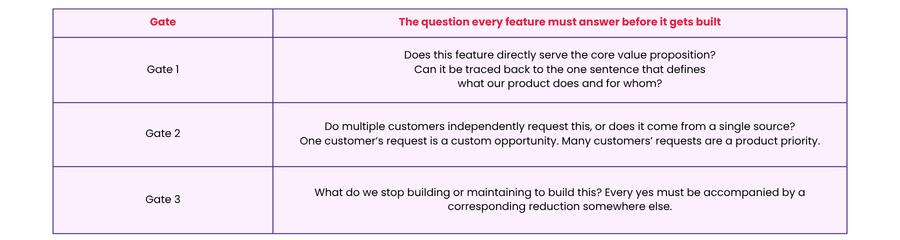
A feature filter is a set of criteria every request must pass before it is added to the development roadmap. Not a bureaucratic process. A lightweight, consistent evaluation that forces the team to think before they build.
The products that resisted feature creep
Some of the most successful products in the world have been defined as much by what they refused to build as by what they built.
- Basecamp famously refused to add features every competitor had. No time tracking. No invoicing. No Gantt charts. The founders were explicit about it, publicly and repeatedly, and built a business worth hundreds of millions of dollars on the back of that restraint.
- Superhuman launched with a product that did less than Gmail in almost every measurable dimension. What it did, it did with extraordinary speed and precision. The waitlist reached six months. The NPS scores were among the highest ever recorded for a productivity tool.
- Apple’s iTunes is the cautionary tale from the other direction. Originally a simple media player, it expanded to include music purchases, podcasts, TV shows, device synchronisation, and more — transforming into a bloated, sluggish experience. Apple ultimately discontinued it in 2019 in favour of separate, focused apps.
Focus compounds. Complexity compounds. The product becomes more and more of what it started as. The question every founder must answer, consistently and with discipline, is which direction they want that compounding to take them.
Where does Volumetree fit into this?
The story above is about what happens when a product grows without a forcing function. When every request becomes a feature, and every feature becomes a permanent commitment, the product slowly stops being the thing that made the first customers love it.
Volumetree is a global technology partner that helps founders and businesses build and scale tech and AI products within weeks.
Their teams work with founders at the point where scope discipline matters most: the beginning. When decisions about what to build and what not to build are the cheapest to make and most consequential to get right.
The difference between a product that compounds in the right direction and one that slowly fragments is almost always made in the first six months of development. If you are at the beginning of a build, before the feature requests start accumulating, the most valuable conversation you can have is about what the product should never do. Volumetree is built to have that conversation.
Visit: volumetree.com
Final thoughts: the features you do not build
The features you do not build are invisible. Nobody writes a changelog for them. Nobody presents them at a board meeting. They produce no demos, no customer testimonials, no investor slides. They look like inaction.
They are not inactive. They are the decisions that keep your product focused, your codebase maintainable, your team motivated, and your positioning clear. Every feature you choose not to build is a decision to keep doing the original thing better, rather than doing more things adequately.
The startups that survive are not the ones that build the most features. They are the ones who build the right features and have the discipline to know the difference.
The founder in this story knew the difference, eventually. She just knew it six months too late.
Key takeaways
- Feature creep enters through four consistent entry points: customer request pressure, investor suggestions, “while we’re in there” engineering additions, and competitive anxiety.
- The real cost goes far beyond development time. It costs user retention, team morale, product positioning, fundraising credibility, and the loyalty of the original customers who loved the first version.
- Feature creep rarely feels like a mistake in the moment. Each addition sounds reasonable. Collectively, they sink the product.
- The feature filter has three gates: does it serve the core value proposition, do multiple customers independently request it, and what do we stop doing in order to build it?
- Products that resist feature creep are defined as much by what they refused to build as by what they built. Focus compounds. Complexity compounds.
- The features you do not build keep the product focused, the codebase maintainable, the team motivated, and the positioning clear.
- A partner like Volumetree can help founders make the right scope decisions at the beginning of a build, before the pattern of feature creep has a chance to establish itself.
Ready to build a focused product that holds its ground?
Volumetree is a global technology partner specialising in building and scaling tech and AI products within weeks. Our team work with founders who are ready to build focused, excellent products without the scope creep that quietly destroys early-stage momentum.
➡ Talk to us: volumetree.com
Reach out to us to talk about your product.
Check how we impacted 80+ clients in 17+ industries: See our work
Get a free trial of our Voice AI Hiring platform: Easemyhiring.ai


 Global Operations


