
table of contents
- Why traditional roadmaps fail early-stage founders?
- The four types of unknowns in early-stage products
- The principle: Treat your roadmap as a hypothesis log, not a feature calendar
- Step 1: Start with assumptions, not features
- Step 2: Replace timeline columns with confidence columns
- Step 3: Build your discovery engine before you build your features
- Step 4: Use the now-next-later structure instead of quarterly timelines
- Step 5: Write outcome targets, not feature lists
- Step 6: Build feedback loops that surface what you didn’t know to look for
- Step 7: Review and update the roadmap on a cadence that matches your uncertainty
- What does a hypothesis-driven roadmap look like in practice?
- The three mistakes that kill early-stage roadmaps
- Where does Volumetree fit into this?
- Final thoughts: the map is not the territory
Published: March 2026 | Reading Time: ~14 minutes
Every founder who has sat down to build their first product roadmap has encountered the same quietly terrifying moment.
You open the template. You start filling in the columns. Q1, Q2, Q3. Feature, timeline, owner. And then, somewhere around the third row, the question arrives: how do I plan for things I have not thought of yet? How do I build a roadmap when I genuinely do not know what the market will tell me, which features will matter, or whether the assumptions I am planning around are even correct?
This is not a planning failure. It is the honest condition of every early-stage product team. This blog is for founders and product teams in that earlier, more uncomfortable position. The position where you have an idea, some early signal, and a team that needs to know what to build next, but you genuinely do not know what you do not know.
Why traditional roadmaps fail early-stage founders?
The traditional product roadmap was designed for a different context. It evolved inside large organisations with stable customer bases, known product categories, and enough historical data to make reasonably confident predictions about what users would want next.
Early-stage founders have almost none of these things. And yet they are handed the same framework, told to fill it in, and expected to present it to investors, co-founders, and hiring candidates as though it represents a considered plan.
Traditional roadmaps fail early-stage founders in three specific ways:
- They incentivise false precision. Committing to a feature list for the next six months implies you know what the market will tell you in month one. You do not. Nobody does.
- They anchor thinking around features rather than questions. What early-stage teams actually need is a framework for deciding what to learn, not what to build. Those are different orientations.
- They conflate certainty with confidence. What early-stage products need is not certainty. It is a rigorous process for navigating uncertainty. A detailed roadmap signals the former while requiring the latter.
The four types of unknowns in early-stage products
The phrase “unknown unknowns” maps directly onto the product challenge at the early stage. Four categories of knowledge affect every product decision:
- Known knowns: Things you understand and know you understand. You know your product needs authentication. These go in the roadmap with confidence.
- Known unknowns: Things you know you do not know yet. You need to validate pricing sensitivity but have not tested it. These belong on the roadmap as questions, not features.
- Unknown knowns: Things you know implicitly but have not articulated. The assumptions baked into your architecture and onboarding flow that nobody has written down. Dangerous because they are invisible.
- Unknown unknowns: Things you do not know you do not know. The customer behaviour you did not anticipate. The competitor who enters your category. By definition, you cannot plan for these — but you can build a process that surfaces them quickly.
The goal of a roadmap built for uncertainty is not to eliminate unknown unknowns. It is to build the discovery mechanism that converts them into known unknowns as fast as possible.
The principle: Treat your roadmap as a hypothesis log, not a feature calendar
A traditional roadmap says: here are the features we are building in the next six months. A hypothesis-driven roadmap says: here are the assumptions we are testing in the next six months, here is how we are testing them, and here is what we will build next depending on what we learn.
The hypothesis log structure: what do we believe, what would convince us we are right, what would convince us we are wrong, and what is the cheapest and fastest way to find out? Those four questions, applied to your most important product assumptions, are more valuable than any feature-first roadmap at the early stage.
| Realistic platform roadmaps in 2026 are built on empirical evidence, iterative execution, and alignment with business objectives. The teams winning are those with the most rigorous process for responding to what they learn. |
Step 1: Start with assumptions, not features
Before you write a single feature on your roadmap, write down every assumption your product depends on. Not the confident ones. All of them. A useful prompt: if any of these assumptions turn out to be wrong, our product as currently conceived does not work.
Common assumptions early-stage products rest on without ever being stated:
- The target customer experiences this problem at the intensity we believe they do.
- The customer has the budget and authority to pay for a solution.
- They will change their workflow to adopt a new tool.
- The core workflow we have designed matches how they actually think about the problem.
- The price point we have modelled is acceptable to the segment we are targeting.
Rank each assumption by two dimensions: how much does the product depend on this being true, and how confident are you that it is true? The assumptions scoring high on the first and low on the second are your highest-priority learning tasks. Build the roadmap around resolving those first.
Step 2: Replace timeline columns with confidence columns
Instead of organising your roadmap by quarter or month, organise it by confidence level. Three columns:
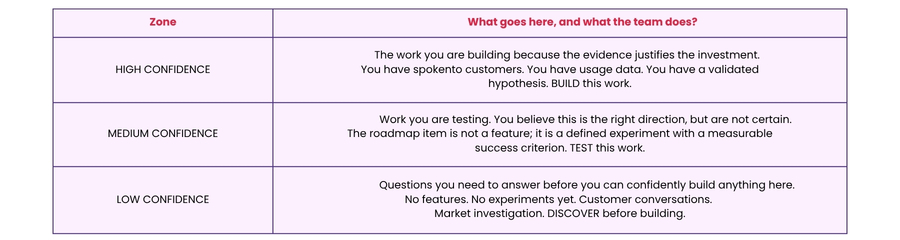
This structure makes your uncertainty explicit rather than hidden. It creates a natural mechanism for promoting items from low confidence to medium to high as you gather evidence. And it prevents the most common early-stage failure: committing engineering resources to building things you have not yet validated.
Step 3: Build your discovery engine before you build your features
A discovery engine is the ongoing mechanism by which your team generates and tests product hypotheses. It is not a one-time phase at the beginning. It is a permanent, embedded part of how the product team operates.
The minimum viable discovery engine for an early-stage product team:
- Regular customer conversations. Not occasional. Weekly, with a consistent format that produces comparable data over time. A minimum of one meaningful conversation per week per product manager.
- Usage data review. Weekly review of the most important product metrics, with explicit discussion of what surprised the team, what behaved as expected, and what the data implies about the next experiment.
- Assumption tracking. A living document where key assumptions are recorded along with evidence for and against each. Reviewed monthly and updated whenever anything changes the picture.
- Experiment design. A structured process for designing tests around medium-confidence hypotheses. A defined hypothesis, a measurable success criterion, a time box, and a decision rule for what happens at the end.
| 92% of product leaders are responsible for revenue. Yet only 26% have high visibility into the ROI of their launches. A strong roadmap built on discovery closes that gap. |
Step 4: Use the now-next-later structure instead of quarterly timelines
Rather than committing to specific dates, organise work into three time horizons: what the team is actively working on now, what is in preparation and will begin next, and what the team is thinking about later but has not yet committed to.
This structure communicates direction without over-committing to timelines that will be wrong. It keeps the team focused on the present without losing sight of the future. And it makes prioritisation conversations productive: “X is in later because we have not yet validated that it is the highest-impact thing to build next. Here is what we would need to learn to promote it.”
Step 5: Write outcome targets, not feature lists
A feature-based roadmap item: “Redesign onboarding flow.”
An outcome-based roadmap item: “Reduce time from sign-up to first meaningful action from eight minutes to under three minutes.”
These might produce the same work. But they produce it differently. The outcome item tells the team what success looks like. It creates a measurable test. It opens the question of whether there are multiple ways to achieve the outcome. The feature item closes that question before it is asked.
If you cannot write the success criterion for a roadmap item, you are not yet ready to build it.
Step 6: Build feedback loops that surface what you didn’t know to look for
Unknown unknowns do not appear in your hypothesis log. They appear in the places you were not paying attention. Surfacing them requires deliberate mechanisms:
- Open-ended customer conversations. “Tell me about your week. What was frustrating? What took longer than it should have?” These surface problems you did not know existed.
- Churn interviews. Customers who left without telling you why are carrying your most valuable information. Conduct a structured interview within two weeks of any cancellation.
- Support ticket analysis. Weekly review of support tickets, categorised by theme, is one of the most reliable mechanisms for discovering things you did not know to look for.
- Competitor watching. The features your competitors are shipping tell you what the market is asking for. If a competitor invests in a category of functionality, the unknown unknowns in that area are being resolved for others.
- Cross-functional conversations. Your sales, customer success, and support teams are in daily contact with customer reality. A structured weekly conversation between the product and these functions is essential.
Step 7: Review and update the roadmap on a cadence that matches your uncertainty
A roadmap reviewed once a quarter is appropriate for a team with stable, validated foundations. For an early-stage team operating in genuine uncertainty, it is too slow.
- Weekly: A check of whether anything in the last seven days has changed the picture enough to promote, demote, or reframe a roadmap item.
- Monthly: A thorough review of the assumption log, completed experiments, support ticket themes, and churn interviews. Does the now-next-later structure still reflect your best understanding?
- Quarterly: A strategic step back. Are you still building toward the right outcome? Has the market shifted? Have four months of discovery changed your view of who the product is for?
The roadmap is not a contract. It is the current best understanding of the most valuable next thing to learn and build. Updating it when the evidence changes is not a failure of planning. It is planned to work correctly.
What does a hypothesis-driven roadmap look like in practice?
Here is a concrete example using a SaaS tool for operations managers at logistics companies:
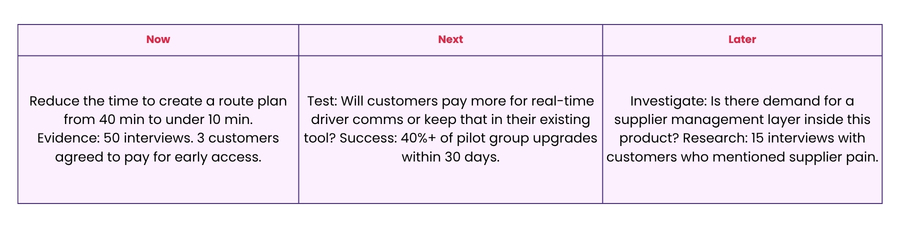
Notice what this roadmap does not contain: a launch date, a feature list for Q3, or anything in “later” disconnected from a specific learning question. What it does contain is a clear picture of where the team is confident and why, where they are testing and how they will know if the test succeeds, and where they are still discovering.
The three mistakes that kill early-stage roadmaps
Confusing activity with learning
Shipping features are satisfying. It produces visible, tangible output. But at the early stage, what the team is learning is the point. A week in which the team shipped two features but did not learn anything new about the customer is a week of reduced velocity, not increased velocity.
Building for the customer you imagined rather than the customer you have
The customer you imagined when you wrote the business plan is not the same as the customer who is actually using your product. As real customers reveal their actual behaviour, the product needs to respond to that reality. The roadmap is the mechanism for making that response systematic rather than reactive.
Treating roadmap updates as admissions of failure
When your evidence changes, updating the roadmap is evidence that the discovery process is working. A roadmap that never changes is not a sign that the team planned well. It is a sign that the team is not learning.
Where does Volumetree fit into this?
Building a product roadmap in genuine uncertainty requires two things simultaneously: the discipline to build a rigorous discovery process, and the technical capability to move quickly when the evidence tells you what to build.
Volumetree is a global technology partner that helps founders and businesses build and scale tech and AI products within weeks.
Our team works with founders at exactly the point where a hypothesis has been validated and needs to become a working product, fast enough to capitalise on the evidence before the market changes.
In 2026, the winning product teams are not the ones with the most detailed roadmaps. They are the ones with the most rigorous discovery processes and the fastest execution of what the discovery reveals. Building both sides of that equation at once is what Volumetree helps founders do.
Visit: volumetree.com
Final thoughts: the map is not the territory
At the early stage, you are building both the map and discovering the territory simultaneously. The map will be wrong in places. That is not a problem. It is the nature of the work.
A hypothesis-driven, confidence-organised, outcome-focused, regularly updated roadmap is a map-making process for genuinely uncertain terrain. It will not tell you what you do not know. But it will ensure that what you do not know becomes known as quickly and cheaply as possible.
And in product development, that is the only kind of roadmap that ever actually worked.
Key takeaways
- Traditional roadmaps fail early-stage founders because they were designed for stable, validated environments. Early-stage teams need a different kind of document entirely.
- Four types of unknowns: known knowns (build), known unknowns (experiment), unknown knowns (examine assumptions), unknown unknowns (build discovery mechanisms to surface them).
- Treat your roadmap as a hypothesis log. The artefact is the assumption, not the feature. Make it explicit. Test it. Update the roadmap when you learn.
- Replace timeline columns with confidence columns: high confidence (build), medium confidence (experiment), low confidence (discover).
- Use the now-next-later format instead of quarterly timelines. It communicates direction without over-committing to schedules that will be wrong.
- Write outcome targets, not feature lists. If you cannot write the success criterion for a roadmap item, you are not yet ready to build it.
- Build deliberate mechanisms to surface unknown unknowns: open-ended conversations, churn interviews, support ticket analysis, competitor monitoring, and cross-functional conversations.
- Update the roadmap at a cadence that matches your uncertainty: weekly check-ins, monthly reviews, quarterly strategic assessments.
- A roadmap that never changes is not good planning. It is a sign that the team is not learning.
- Volumetree can help you close the gap between rigorous discovery and fast execution, building what the evidence supports before the market moves on.
Ready to turn your hypothesis into a product that ships?
Volumetree is a global technology partner specialising in building and scaling tech and AI products within weeks. Their teams work with founders who have done the discovery work and need a technical partner who can build on that foundation without wasting what the validation has earned.
Get in touch with the Volumetree team today at volumetree.com and turn your idea into a real business.
Reach out to us to talk about your product.
Check how we impacted 80+ clients in 17+ industries: See our work
Get a free trial of our Voice AI Hiring platform: Easemyhiring.ai


 Global Operations


